Panna tournament
at your venue
Short matches in a round cage, with a tournament schedule around it. We bring the cage, set it up and run the tournament.
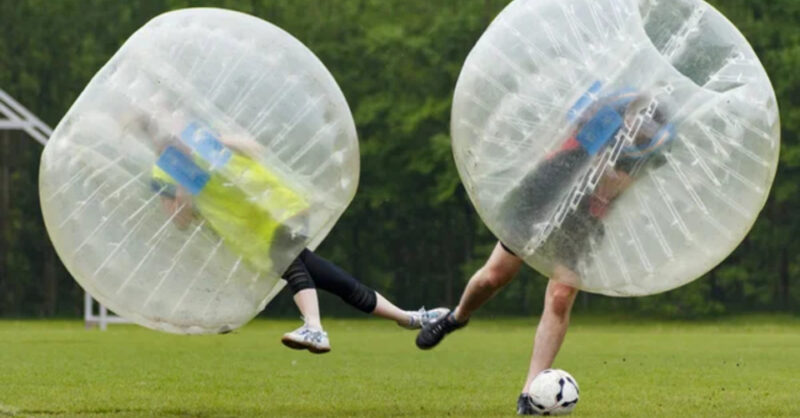
Why a schedule works better than free play
A cage without a schedule is taken over within a quarter of an hour by the five best footballers, and the rest stand watching. With a tournament schedule everyone gets a turn and every child knows when they play again. That is why we always set it up as a tournament, even at a neighbourhood party where people come and go.
We bring the cage, set it up and take it away again afterwards. We don't have a site of our own: the cage goes where you have space, or to a place we arrange if there isn't one.
- Cage, balls, tournament schedule and hosting included
- We do the set-up and take-down, outside the playing time
- A flat area of about 12 by 12 metres is needed
- Works from around age eight, in groups by age
How does a panna tournament run?
A panna tournament runs in groups towards a knockout stage and a final, with room for free play in between. Allow two to three hours for a group of thirty children.
The group stage
Everyone plays a few short matches against different opponents. That way nobody is out of the game after losing a single match.
The knockout
The best players from the groups play on. From here it goes match by match, and the crowd around the cage gets audibly bigger.
The final
Two players, slightly longer playing time and everyone around them. A panna in the final is the moment the rest of the day gets talked about.
Free play in between
Between rounds the cage is free, so anyone who has been knocked out can still keep playing instead of waiting.
Who supervises during the tournament?
We stand by the cage the whole time, keep track of the schedule and referee the matches. For a group of up to about thirty children, one of our instructors is enough, and above that we add another. What we ask of you is that an adult from your organisation stays nearby who knows the children, because with a grazed knee or a bad mood that is someone they trust.
We make sure there are never more than two players in the cage at once and that waiting children keep their distance. Trainers are handy, football boots with studs are not, and we also put that in the confirmation so parents know in advance.
A compact set-up starts at €195. After the first conversation you'll get a firm price.
Frequently asked questions
What exactly is panna?
Panna is a form of football played one on one in a round cage, where you win by scoring or by playing the ball between your opponent's legs. That last move is called a panna and ends the match immediately. A match therefore rarely lasts longer than two minutes.
What surface do you need?
The cage stands on a flat area of about twelve by twelve metres, including space around it to watch. Grass, artificial grass, asphalt and paving are all suitable. We don't set it up on steeply sloping ground or on loose sand, because the ball then goes in all directions.
From what age does a panna tournament work?
From around age eight the tournament format works well, because children then understand that they have to wait their turn. Under eight we make it a continuous format without a tournament schedule. For mixed ages we play in two groups, otherwise the youngest have no chance against the oldest.
Does a panna tournament go ahead in the rain?
Light rain isn't a problem: the cage and the ball can handle it. In persistent rain or thunderstorms we stop, because a wet surface combined with fast turns leads to injuries. We agree in advance up to what point you can switch to something indoors.
Tell us about your plan
Interested in a panna tournament? Fill in the short form and we'll send a price estimate within 1 working day.
A cage on your square or field
Tell us how many children are coming and what kind of surface there is.