Playful marketing stunts: twelve examples and when they work
A playful stunt works when people take part themselves and then talk about it afterwards. Twelve examples, the conditions, and what you need to arrange with the municipality.
A playful campaign works when people laugh at it, do something themselves and then tell someone else about it. If one of those three is missing, you're left with a funny moment nobody connects to your brand. Below are twelve examples of playful marketing campaigns, when they work and what to arrange beforehand.
What makes a campaign playful?
A playful campaign surprises. Something is in a place you don't expect, or something happens you didn't see coming. That alone is enough for attention, but not for results. The campaigns that work get people to take part: playing, guessing, searching, choosing. People who've taken part remember whose it was.
The joke also has to be about your brand. A campaign that could have suited any other company is remembered as a fun campaign, not as your campaign.
Twelve examples of playful marketing campaigns
1. A scoreboard in the city
A skill game on a square, with a scoreboard showing the best scores all day. People keep watching, come back to defend their place and spread the word.
2. A shop window that joins in
A guessing game in the window: how many balls are in the display case, what is this object. People can take part via a QR code on the glass, even when the shop is closed.
3. A spin of the wheel on the street
A wheel with prizes and questions about your product. Spinning costs nothing, the result is immediate and the question that comes with it starts the conversation.
4. Hidden objects in the city
Ten objects with your logo hidden in well-known places, with hints on social media. Whoever finds one wins a prize. Works for a local business that wants to become known in the neighbourhood.
5. A living shop window
Someone in the window doing what your product is for: sleeping in a bed, working at a desk, cooking in a kitchen. People stop because it's unusual.
6. A flash mob with a reason
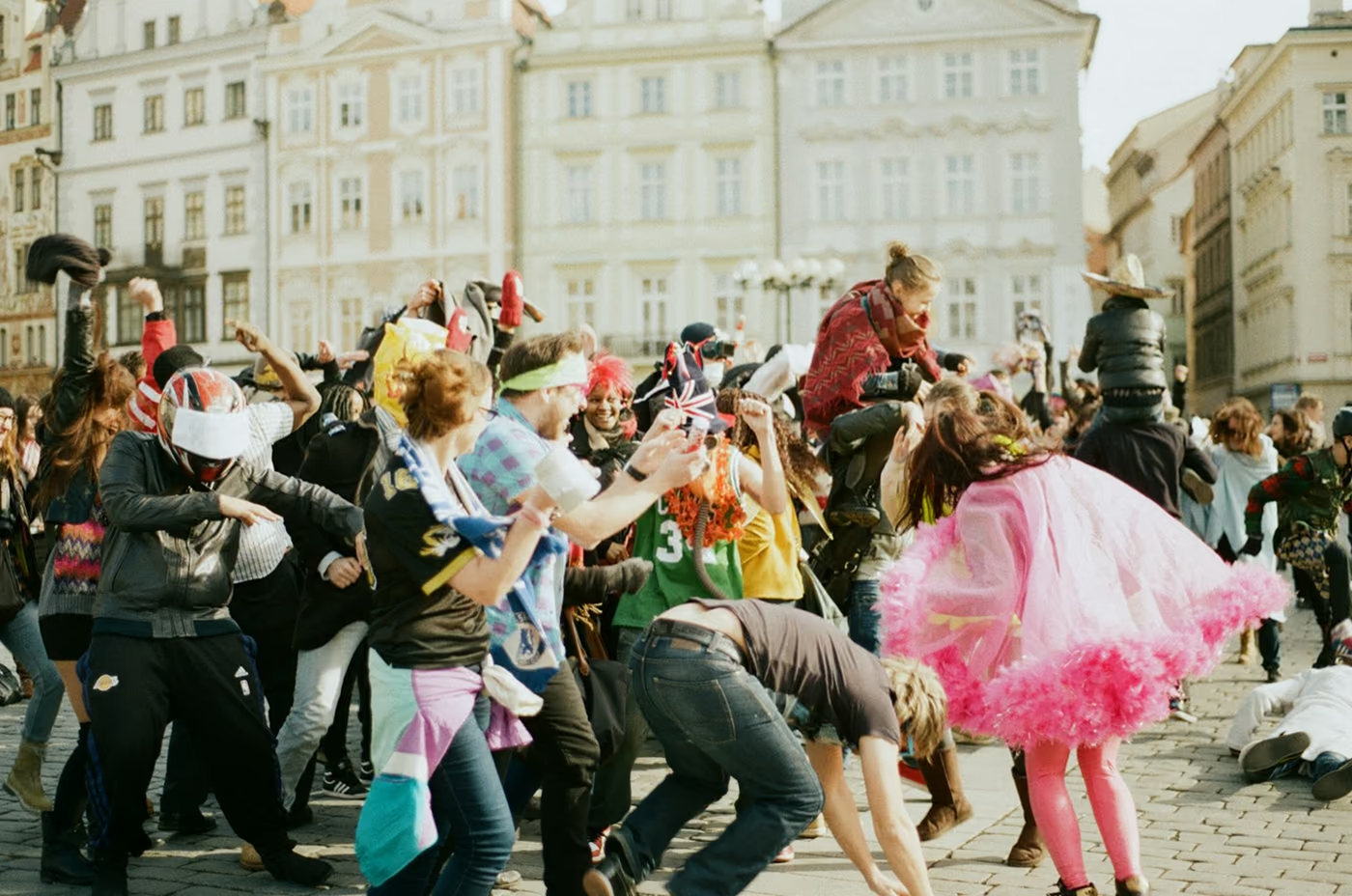
A group that suddenly does something related to your brand on a busy square. Without that link it's just a video. With the link, the viewer knows what it was about.
7. Something free in exchange for an action
Free coffee for anyone who answers a question, a product for anyone who plays a game. The action makes it memorable, the free part makes people stop.
8. A quiz where people wait
A station, a waiting room, a queue for a festival. People have time and are bored, so a short quiz on their phone gets played instead of ignored.
9. Pavement chalk or reverse graffiti
A message on the pavement, made by spraying dirt away instead of using paint. Eye-catching and temporary, but ask permission first.
10. A challenge between companies
A game where employees from different companies play against each other, with a running score that's updated all the time. Colleagues bring in colleagues and the conversation gets going by itself.
11. A pop-up in an unexpected place
A small shop or stand in a container, an old bus or an empty building. The place itself makes people curious.
12. A game on the packaging
A QR code on the product that leads to a short game or a prize draw. The campaign runs for as long as the product is on the shelf and you see exactly how many people take part.
When does a playful campaign work?
- It fits what you sell. The joke only makes sense for your product or service.
- Taking part takes less than a minute. Any longer and people walk on, especially on the street.
- There's something to tell. A score, a prize, a photo: something people talk about later.
- You record something. A QR code, a promo code or contact details with consent. Otherwise you won't know afterwards what it delivered.
What can go wrong?
The biggest mistake is a campaign that gets in other people's way. A flash mob that blocks an entrance or a campaign that leaves a mess gets attention, but the wrong kind. Also think about what it looks like when it isn't working: a wheel nobody spins, or a square where you're standing with three people. So plan a moment when it's busy anyway, or start with something that also works with a small audience.
Arrange permission beforehand. For public space that's usually the municipality, for a shopping centre or station the owner. A campaign that gets shut down halfway through also makes the news, but not the way you want.
How do you measure the result?
Agree beforehand what you're looking at. For a local business that's often the number of people who come in within a month with a promo code. For a brand at a festival, the number of participants and contacts. Whatever you choose, make it measurable before the campaign starts, because afterwards that almost never works.
A campaign the public can take part in
Many of the examples above revolve around a game: a scoreboard, a guessing game, a quiz or a prize draw on the phone. We build promotional games with your own logo in the brand's house style, with participant registration built in, and we're there on the day itself.
Frequently asked questions
What's the difference between a playful campaign and guerrilla marketing?
Guerrilla marketing is the umbrella term for unexpected campaigns in public space on a small budget. A playful campaign is one with a wink, which makes people laugh. Many guerrilla campaigns are playful, but a playful campaign can also simply take place in your own shop or on your own stand.
Are you allowed to just run a campaign on the street?
Not always. Handing things out, putting something up, playing music or using pavement chalk in public space often requires a notification or permit from the municipality. On private ground, such as a shopping centre or station, you need the owner's permission. Check this in good time.
How do you measure whether a playful campaign delivered anything?
Tie the campaign to something you can count: a QR code people scan, a promo code that comes back with a purchase, or the number of people who took part and left their details. Only looking at how much it was talked about says little about what it sold.
Does a playful campaign also work for a B2B company?
Yes, if the joke is about the trade. An installation company that has people play a game about saving energy at home at a trade show stands out more than a stand with leaflets, and the conversation is immediately about the subject.
A campaign the public can take part in?
We build games and prize draws for brands, from a scoreboard in the city to a QR code on packaging, and we're there on the day itself. Tell us what you want to achieve.
View promotional games