Scavenger hunt
made to measure
In a scavenger hunt you only know where to go once you have solved the clue. We write them for the place and for the group.
Why a scavenger hunt runs differently from an ordinary walk
In a scavenger hunt the clue decides where the group goes. You get a riddle, a rebus or a photo of a detail, and only once that is solved do you know which way to go. As a result a group stops every few minutes to confer, and that conferring is what it is really about.
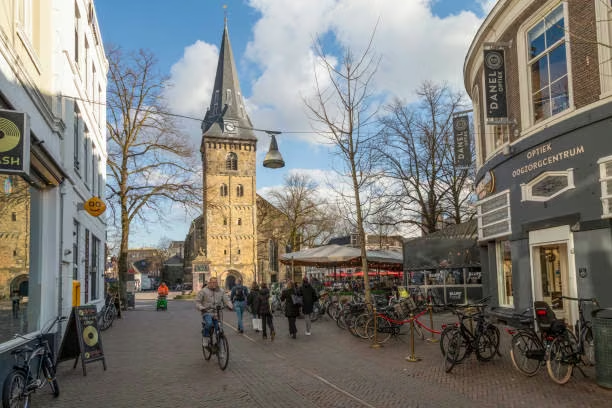
We write the clues on the spot where the trail runs. A lamp post with a number, a facade stone, a sign at the entrance: that's the kind of thing we hook a clue onto. A ready-made trail can't do that, because it doesn't know what is on your corner.
What we provide
You provide the group and a start and end point. The rest comes from us, including the part of the preparation that you only discover when you're halfway: checking that every clue is still correct.
- A route that suits the age and pace of the group
- Clues written for the places that are really there
- Materials for along the way, from task cards to a final puzzle
- Hosting at the start, along the way and at the closing
For children and for adults
A scavenger hunt for children is all about recognition. The clues are short, there is always something to look for or count, and the distance between two points is never so long that attention drifts. A letter at each station that forms a word at the end still works better than any digital alternative.
For adults we raise the bar and make the clues ambiguous. Then a team first has to discuss what is meant before it can even walk. At a company outing we often include something only colleagues will understand, because that gets the most laughs.
When something else is the better choice
A scavenger hunt doesn't suit every group, and we would rather say so beforehand. If you want teams to move freely through the city and choose their own order, a city game makes more sense, because there the points are fixed and the route is not. If what matters to you is as many short tasks as possible without having to walk, look at Crazy 88.
If the emphasis is on thinking and you want to walk as little as possible, a puzzle trail is the better format. And if you want the group to find their own way without clues, you end up with a dropping (Dutch night-time orienteering game).
Frequently asked questions
From what age does a scavenger hunt work?
A scavenger hunt works from about four years old, provided the clues suit the age. For toddlers we use pictures and colours instead of text, for eight- to twelve-year-olds word puzzles and rebuses, and for adults clues you only solve if you look carefully around you. The format stays the same, the difficulty shifts with it.
How long is the route of a scavenger hunt?
The route is usually one to three kilometres, and that is shorter than people expect. Solving takes the time, not the walking. For a group of children that comes to about an hour and a half, for adults two hours including the closing.
Can a scavenger hunt also be done on our own site?
A scavenger hunt can be done on any site with enough fixed landmarks. A business park, a park, a campsite or a village centre all work. We check beforehand which points are usable, because a clue that refers to something that is no longer there brings the whole group to a halt.
What does a tailor-made scavenger hunt cost?
A scavenger hunt with a marked-out route, clues made to measure and hosting starts at €195. The number of groups walking at the same time counts for more than the length of the route. After the first conversation you'll get a concrete price.
Tell us about your plan
Interested in a scavenger hunt? Fill in a short form and we'll send a price estimate within 1 working day.
A scavenger hunt for your group
Let us know how many participants, what age group and where it should run, and we'll send a proposal.