Organising a friends' weekend with a large group
A weekend isn't a long day. How to divide four parts of the day, why the organising belongs with a small group, and what works for people who have known each other for twenty years.
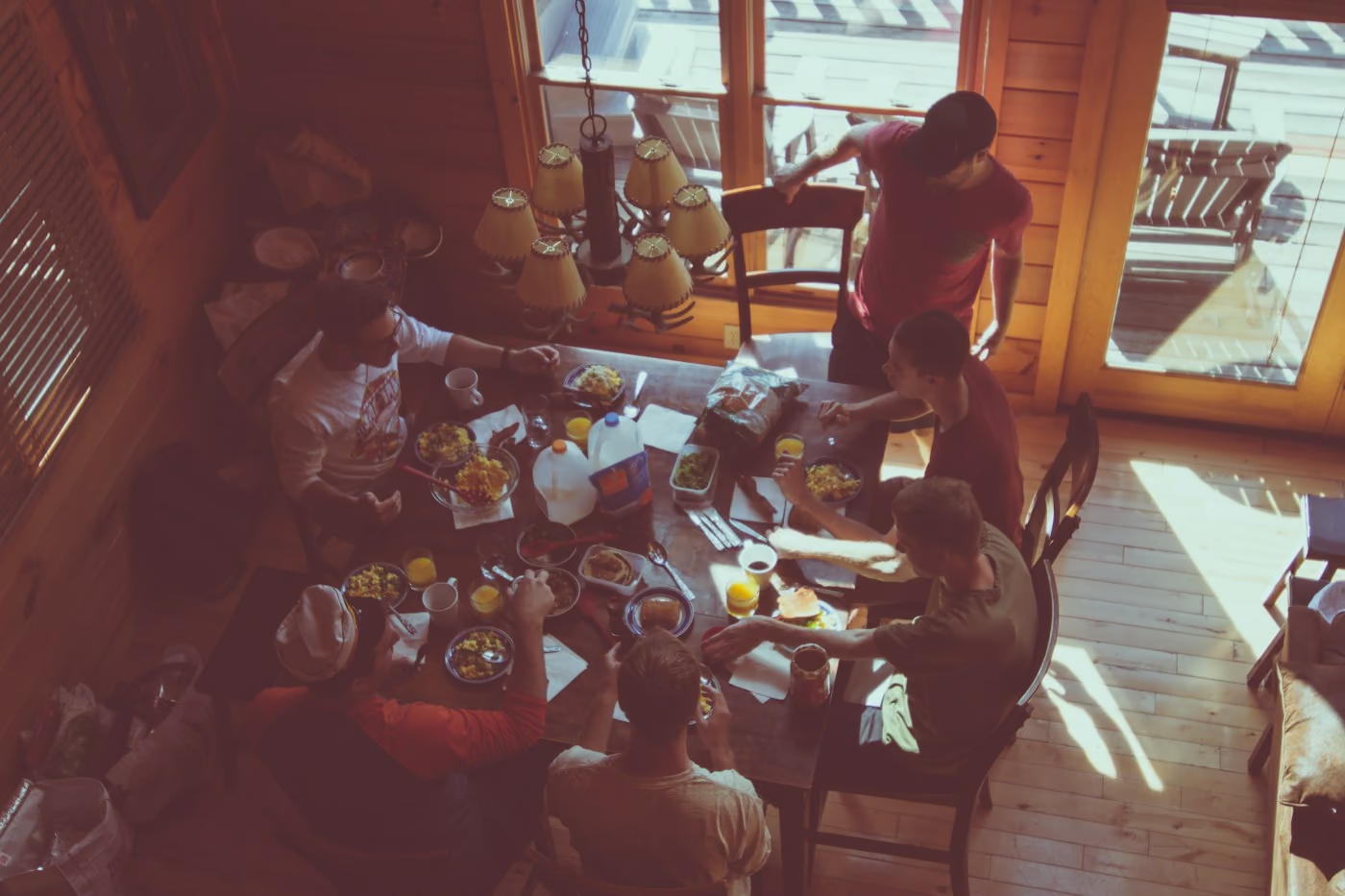
A weekend with friends isn't a long day. That sounds obvious, and it's exactly where most weekends go wrong: a programme is dreamed up as if it were a single afternoon's outing, and then stretched over two days and nights. Below you'll find how to divide up the parts of the day, why the organising belongs with three or four people and not the whole group, and what works for people who've known each other for twenty years.
Why a weekend works differently from a day
With an afternoon outing the question is: what are we going to do. With a weekend the question is: when do we do nothing. A group that's busy non-stop from Friday evening to Sunday afternoon is silent at the breakfast table on Sunday morning, and not out of contentment.
Work with four parts of the day: Friday evening, Saturday morning, Saturday afternoon and Saturday evening, with Sunday morning as the wind-down. Fill two with something organised and leave the rest open. The empty parts aren't the leftovers, that's where people really talk to each other. The organised part is there to get those conversations going.
The second difference is that you can't call a weekend off. An afternoon that disappoints is over by five o'clock. A weekend that sets the wrong tone on Friday evening gets dragged along for another day and a half. That's why the opening is more important than the main programme.
Who organises it?
Three or four people, and not the whole group. That's the most important decision of the whole weekend and it's rarely made consciously.
With two organisers it's too much work. A weekend needs a venue, places to sleep, food for several occasions, transport and a programme. That's more than two people can do alongside their jobs without it becoming a strain.
With five or more you have to consult each other again, and the same pattern returns that you tried to avoid in the big group: every suggestion prompts a counter-suggestion. Three or four is the size where you can split the work and still decide quickly.
Rotate the organising
Agree that a different group does the next weekend. That doesn't just share the work, it keeps the weekend fresh. Every organising group adds its own emphasis, and after three or four editions the group has a tradition without anyone permanently carrying it.
A theme or not?
A theme helps if it gives direction and not if it's compulsory fancy dress. The difference lies in what's asked of people. A theme that determines what the tasks are about works. A theme where everyone has to wear something divides the group straight away into people who enjoy it and people who feel uncomfortable.
What works well for a group that has known each other a long time is themes that bring something back: how well do you still know each other, what's changed, who was who ten years ago. That produces activities that only work for this group and that you can't buy anywhere.
Do keep the theme away from the food and the sleeping. A group that's in a concept all weekend gets tired of it. Two activities attached to it is enough.
What works for a group that has known each other for years?
The pitfall with a group like that is that everyone already knows everyone's role. The funniest makes the jokes, the most competitive wins, the quietest says nothing, and afterwards nothing has changed. A programme that confirms those roles feels pleasant and produces nothing new.
What does work is activities in which someone can be good at something the rest knew nothing about. Not because that's exciting, but because it's the only way a group that already knows each other still finds out something about each other.
Also make sure nobody has to stand in front of the group alone. In a gathering of twenty-five there's always someone who dislikes that, and that person never says so out loud. Activities in pairs or small teams remove that barrier without you having to say anything about it.
Couples against each other
If the group consists largely of couples, the temptation is to do everything in pairs. Do that for one activity and mix for the rest. A weekend in which you're constantly standing next to your own partner produces the conversations you'd have had at home anyway.
That one activity in which couples do face each other is then the one that gets the most laughs. Keep it light: questions whose answers embarrass nobody, and no subjects with a real disagreement underneath.
How do you plan the Saturday?
Don't start the organised part before eleven o'clock. In a group of twenty-five some are up at eight and some at half past ten, and you won't close that gap with an alarm clock. A start at eleven means everyone's there and nobody feels they had to rush.
Plan the toughest activity for the afternoon and not the evening. After dinner energy dips and the group gets chattier. An active programme that starts at nine in the evening loses half the group to the bar, and that half are usually right.
Leave at least an hour and a half between two activities. A group this size moves slowly, and the conversation that gets going after an activity is often more valuable than the next activity.
Indoors or outdoors
Choose outdoors as the first choice and agree in advance what happens if it can't happen. Fix the moment you'll decide, for example nine o'clock on the morning itself, and say straight away what the alternative is.
That alternative doesn't have to be a second complete programme. Often it's enough to know which room is available indoors and which activity you'd drop. A group that knows the plan accepts rain. A group that hears at eleven o'clock that it's off spends the rest of the day on their phones.
What does a weekend with friends cost?
Most of your budget goes on accommodation and food, not on the programme. With group accommodation you usually end up between fifty and a hundred euros per person for two nights, depending on the region and the season.
If you have an activity run for you, a compact activity for part of a day starts at €195 for the whole group, from 6 people. With twenty-five people that's about €8 per person. A bigger programme with several activities or its own theme is between €550 and €1,250.
Name the amount per person before people say yes. In a group of twenty-five there's always someone for whom it matters, and who won't say so unprompted.
When do you have part of it run for you?
If you want to join in yourself. Whoever runs the programme is always on the sidelines: they keep track of time, know what's coming and never have a moment with nothing to think about. For a weekend that happens once a year or once every two years, that's a waste for the people organising it.
The second reason is that working out your own theme takes more time than you think. Coming up with tasks that suit this particular group, sorting materials and keeping the whole thing running without lulls is three evenings' work or so. What we do there is covered under private outings, and the individual activities are on the page with all activities.
If you're mainly looking for a day rather than a whole weekend, the article on organising a day out with friends is more practical. If it's a group of over twenty, the game formats that suit it are in group games for a large group.
Frequently asked questions
How many parts of the day should you fill in a weekend with friends?
A weekend from Friday evening to Sunday afternoon has four parts of the day. Fill two and leave two empty. A group with a programme running non-stop from Friday evening to Sunday afternoon is spent by twelve o'clock on Sunday. The empty parts are where people really talk to each other.
How many people should organise a weekend with friends?
Three or four, not the whole group. With two it's too much work for one weekend, with five or more you have to coordinate again and it leaks out. Three or four people can share the work and keep a surprise secret.
Does it work if the group consists of couples?
Yes, but don't put couples on the same team by default. A programme where you're next to your own partner the whole time produces exactly the conversations you'd have had at home. Mix for most activities and keep one activity in which the couples do face each other.
What does an activity cost during a weekend with friends?
A compact activity for part of a day starts at €195 for the group, from 6 people. With twenty-five people that comes to about €8 per person. A bigger programme with several activities or its own theme is between €550 and €1,250.
How do you keep a surprise programme secret in a group chat?
Set up a second chat with just the organisers and in the big chat communicate only times and what people need to bring. The surprise almost always leaks through someone trying to say something nice, not through a gap in the planning.
Would you rather not arrange it yourself?
We design and run the whole programme, at your venue or somewhere in Twente. Tell us what you have in mind and we'll send a proposal with a price.
Request a proposal