Team building exercises that actually get things moving
An exercise only works if nobody can finish it on their own. Formats for different situations, with the duration and the exercises you're better off skipping.
Most lists of team building exercises are a loose pile: twenty games with no explanation of when to use which. That's no use when you're standing in front of a team that works together stiffly on Monday morning. Below are formats ordered by what they do, when they suit which group, how long they take, and which you're better off skipping. For the question of what kind of programme you want in the first place, there's a separate article on team building concepts.
What makes an exercise a team building exercise?
A team building exercise is a format in which the team has to solve something that one person can't do alone. That's the whole definition, and also the most ignored requirement. Many exercises that go by this name are just games you play side by side.
The difference lies in dependency. If the person with the most knowledge or the strongest arms can finish the exercise alone, that's what happens, and the rest look on. If the exercise only works when information is spread across several people, they have to talk. That's the mechanism everything turns on.
In addition, a good exercise has a visible end. A team should be able to tell whether it succeeded. Without a clear outcome it stays an exercise without tension, and a group of adults loses interest in that faster than people think.
When do you use an icebreaker and when not?
An icebreaker is useful if the group barely knows each other, and unnecessary to annoying if they've worked together for years. That sounds logical, yet a large share of team days still open with an introduction round in a team of eight people sitting next to each other.
Use an icebreaker with a newly formed team, with a group from different departments, or when several new colleagues have joined. Skip it with an established team. Start there with an exercise that's about something straight away, because then the group is into the substance within two minutes instead of going through the motions.
Five icebreakers that aren't awkward
Most icebreakers fail because they make people share something personal with strangers. These five don't ask that.
- Two truths and a lie, but about work: three statements about your own work experience, and the group guesses which one isn't true. Takes about a minute per person and always leads to a follow-up question.
- Finding a common trait: in groups of four, find something that applies to all four and isn't work-related. Five minutes. Works because you have to talk to find it.
- Lining up: the group puts itself in order of, say, commute distance to the office, without using words. Three minutes, and everyone moves straight away.
- The first job: everyone names their very first paid job. Short, everyone has one, and it almost always produces stories.
- Drawing from a description: in pairs, one person describes a simple figure and the other draws it without looking. Ten minutes, and it shows straight away how differently people give instructions.
Collaboration games where you really need each other
A collaboration game works when the information or resources needed are deliberately spread across the participants. That's the dial you turn: don't give everyone the same task card.
A few mechanisms that enforce this. Divided information: each team member gets part of the clues and nobody may show their card, only read it out. Limited communication: the group may only speak through one person, or may only ask three questions. Roles with restrictions: one person may see but not speak, another may speak but not see. Shared resource: teams are given too little material between them and have to trade.
That last mechanism is surprisingly instructive, because it shows behaviour that also plays out in the office: do teams negotiate or do they hoard? We often build this into a team games day, where teams compete against each other but for one part actually need something from each other.
Team building exercises for a small team
With a team of four to eight people, exercises work in which everyone has a clear role, because in a group that size there's nowhere to hide. That's an advantage you don't have with a large group.
What works well at this size: an exercise in which the team first has to make a plan and only then may start, with a fixed planning time of three minutes. Almost every small team skips the planning and starts straight away. The second round, in which they do have to plan, shows the difference without anyone having to deliver a theory.
Also useful with small teams: doing the same exercise twice with a different person as leader. That shows that the outcome doesn't depend on the team alone but also on who takes the lead, and that conversation naturally goes further than the exercise.
Exercises for a group that's known each other for years
With an existing team, exercises that break up the usual division of roles work, not exercises in which people get to know each other. Familiarity isn't a problem you have to solve but a given you design around.
Three directions that do that. Let the person who normally decides only advise. Set the exercise in a field where nobody has prior knowledge, so that expertise-based authority drops away for a moment. Or build the exercise so that there are several good answers, so that the conversation is about the choice rather than about who's right.
That last one is what we see come back most often in what people remember afterwards. A team that discusses for half an hour which solution is best has seen more of each other than a team that quickly opened the right box.
Which exercises are better skipped?
Skip exercises where people are physically dependent on each other's bodies, where someone has to share personal things, or where there's a single winner who mostly got lucky. Those three always cause trouble.
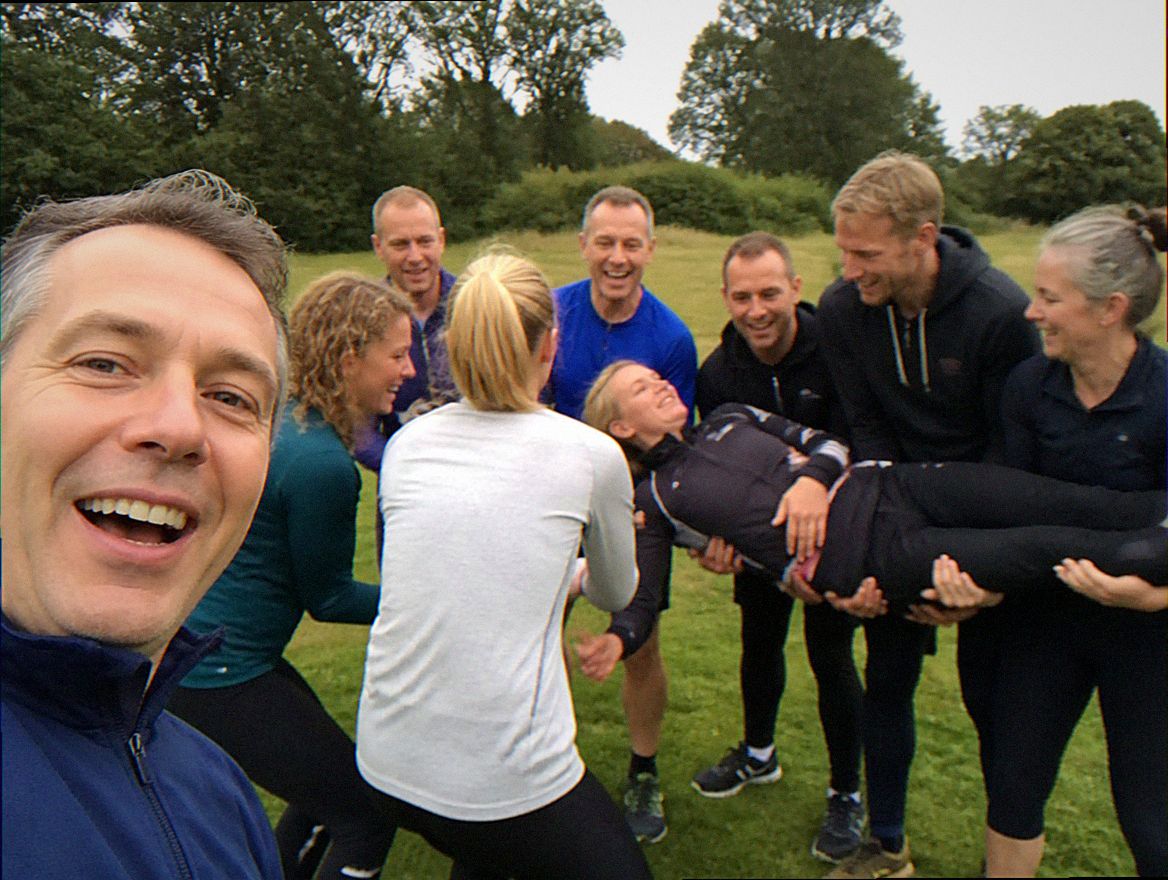
The classic trust fall belongs in the first category. Apart from the risk of injury, it puts people with back problems or a heavier build in an awkward position straight away, which is exactly the opposite of what you wanted to achieve. Exercises where people have to get on each other's shoulders or lift each other: same story.
The second category is about privacy. Sharing something your colleagues don't know yet sounds bonding, but for most people on an ordinary Tuesday it's simply too much to ask. And anyone who isn't comfortable with it will find it hard to decline without standing out.
The third category is subtler. With an exercise where luck decides, the win isn't earned and so isn't fun. A dice roll at the end can add tension, but if the whole result depends on it, the group feels that and the energy drops.
How do you tie loose exercises together?
Loose exercises become a programme once there's a build-up and a running tally. Without those two it stays a series of games, and you notice by the third item.
A structure that works in practice: start short and easy so everyone joins in within two minutes, then an exercise that needs discussion, then a more physical or noisier one to lift the energy, and end with something where the standings can still flip. That last one matters more than it seems, because a programme in which it's already settled halfway through who'll win loses its second half.
Allow five minutes of changeover time between activities. That sounds like little, but with four activities it's twenty minutes that otherwise disappear from your programme. In the article on department outings and team days you'll find how to fit that into a day plan.
What you can do yourself and when to bring someone in
You can easily run loose exercises within your own team yourself. A half-day programme for more than twenty people gets difficult if you're also part of the team.
The reason is simple: running and taking part don't mix well. If you keep time, give the instructions and keep score, you don't see what's happening in the group. And if you join in, the schedule overruns. With a small team that's manageable. With a larger group or a day that really has to produce something, an external host is also a way of being just a participant yourself.
In that case we write the exercises for the situation: which team, what's going on, what should be different afterwards. That's different from a standard package with fixed components. The page on team building in Twente explains how that works.
What does it cost to outsource this?
A compact half-day programme starts at €195 for the whole group. That includes the exercises, the equipment and a host.
A custom programme, where the exercises are written around what's going on in your team, is between €550 and €1,250. For a large group or a full day with several blocks, allow from €1,250. Venue and catering aren't included, because most clients prefer to arrange those themselves.
What you get from this
Choose exercises for what they need to do, not for how fun they sound. For a new team an icebreaker, for an existing team something that breaks the fixed division of roles, and in both cases a format in which the information is divided so people have to talk. Keep exercises between five and twenty minutes, plan five minutes for changeovers, and keep the result open until the end.
If you'd like us to write it around what's going on for you, describe the team and the reason. The page on the overview of activities you'll find the formats we turn this into, from life-size board games to a city game.
Frequently asked questions
What's the difference between a team building exercise and a team building activity?
A team building exercise lasts five to twenty minutes and has a single goal, for example discussing under time pressure or dividing tasks. An activity is the whole around it: a half day or a day in which several exercises are tied together. You can run loose exercises yourself in a work meeting, but an activity is something you organise.
How long does a good team building exercise last?
Allow five to twenty minutes per exercise, plus five minutes of talking afterwards. Shorter than five minutes and a group doesn't get going. Longer than twenty minutes and attention fades, unless the exercise has several phases with a clear moment where something changes.
Do icebreakers also work with a team that's known each other for years?
Not in the classic form. An icebreaker in which people give their name and hobby backfires with an existing team, because that information is already there. With a group like that, an exercise works better in which people discover something new about each other, or in which the usual division of roles briefly doesn't apply.
Can you run team building exercises yourself?
Yes, for loose exercises within your own team an external host isn't needed. What does help is that the host doesn't take part themselves, because then you can keep time and see what's happening in the group. With a programme of several hours or a larger group, hosting alongside taking part becomes too much.
What does it cost to have team building exercises run for you?
A compact half-day programme starts at €195 for the group. A more extensive custom programme, where the exercises are written for your situation, is between €550 and €1,250. For a large group or a full day, allow from €1,250.
How many people can take part in one exercise?
Four to eight people per exercise works best. Under four there's too little discussion, above eight there are always people who lean back because the rest are already solving it. With a larger group you split into teams of that size who do the same exercise side by side.
Ready to get started on your event?
We design a programme that fits your group and run it from start to finish. Book an introductory chat with no obligation, not a sales pitch.
Plan an introduction